Heřmanice
Thermally active
Coal heap (contains coal remains)
26.00
ha
60.0
m height
5.60
mil. m³
1930 - 1990
Period
FPS: --
2D Layers
3D Controls
Loading visualization...
- Land use plan
- According to the Ostrava City Territorial Plan (map portal dated August 14, 2020), the territory of the Heřmanice waste dump is designated as areas with different land use methods, industrial waste landfill – technical reclamation. On the southern part of the Svoboda waste dump as areas with different land use methods, industrial waste landfill - light industry, redevelopment area (change of land use, decontamination). In the section designated for decontamination and light industry development, the risk of thermal process initiation and development must be eliminated. Technical measures must result from thermal monitoring and its evaluation.
| Heap part | Cadastral unit | Parcels | Owner |
|---|---|---|---|
| Heřmanice (odval) | Hrušov (714917) | 1108, 1109, 1111, 1113, 1094/10, 1093, 1092, 1091, 2048, 2049, 1089 | OKK Koksovny, a.s., Koksární 1112, Přívoz, 70200 Ostrava |
| Heřmanice (odval) | Hrušov (714917) | 1104, 1105, 1106, 1107, 1112, 1114, 1128, 1134, 1865, 1866, 1094/8, 1094/9, 1094/1 | DIAMO, státní podnik, Máchova 201, 47127 Stráž pod Ralskem |
| Heřmanice (odval) | Hrušov (714917) | 1094/7 | OKK Koksovny, a.s., Koksární 1112, Přívoz, 70200 Ostrava |
| Heřmanice (odkaliště) | Hrušov (714917) | 1094/10, 1092, 2048, 2049, 1093, 1094/10, 1093,1094/10, 2049, 2047, 1091 | OKK Koksovny, a.s., Koksární 1112, Přívoz, 70200 Ostrava |
| Heřmanice (odkaliště) | Hrušov (714917) | 1094/1 | DIAMO, státní podnik, Máchova 201, 47127 Stráž pod Ralskem |
| Heřmanice (odkaliště) | Hrušov (714917) | 1850/1 | Česká republika, Správa železnic, státní organizace, Dlážděná 1003/7, Nové Město, 11000 Praha 1 |
Svoboda Autoodval
- Volume
- 5.60 mil. m³
- Area
- 26.00 ha
- Max. height
- 60.0 m
- Period
- 1942 - 1990
- Transport technology
- Waste material from the Vítězný únor Coking Plant processing facility transported by cable car, then via 2 skip elevators, with distribution at the summit using dump trucks and tractors.
- Storage technology
- Dumped to the edge from dump trucks at different elevations.
Karolina
- Volume
- 9.00 mil. m³
- Area
- 30.00 ha
- Max. height
- 70.0 m
- Period
- 1930 - 1978
- Transport technology
- By cable car from Karolina, passing over the Petr Bezruč Mine to Ida I, then by belt conveyor to the ridge and along the ridge via belt conveyor.
- Storage technology
- On the ridge a belt conveyor with a scraper, hydraulic flushing to the east and west.
- Heap status
- Inactive
- Status description
- Inactive, partially reclaimed
- Reclamation
- Partially reclaimed
- Reclamation description
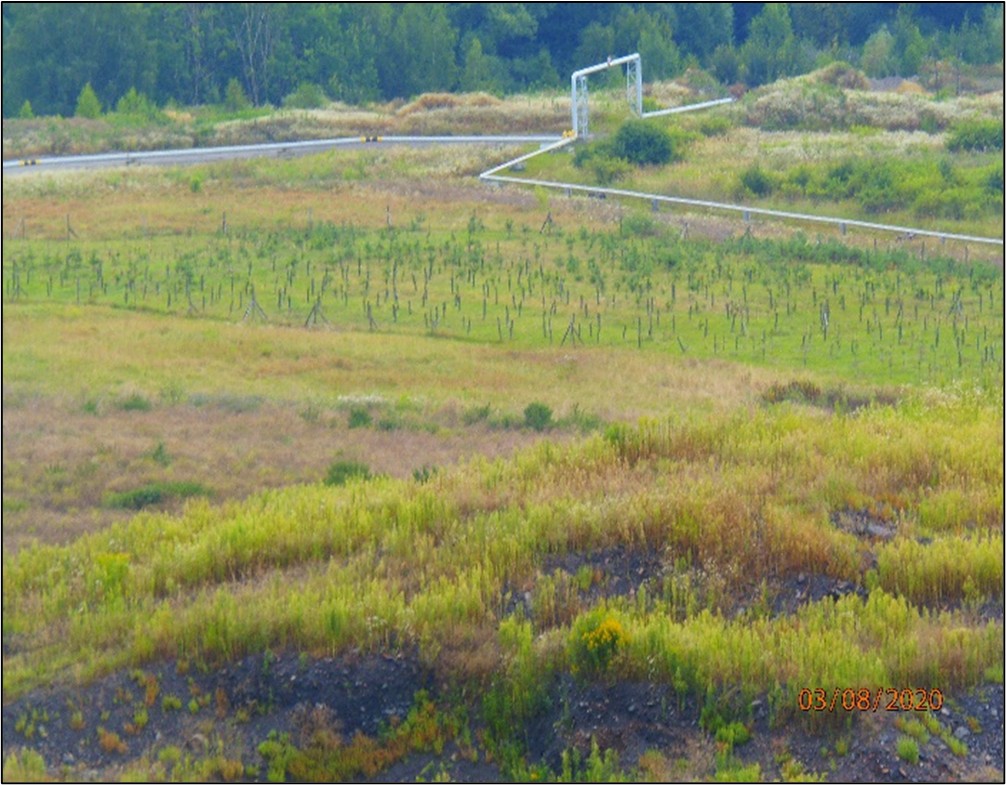
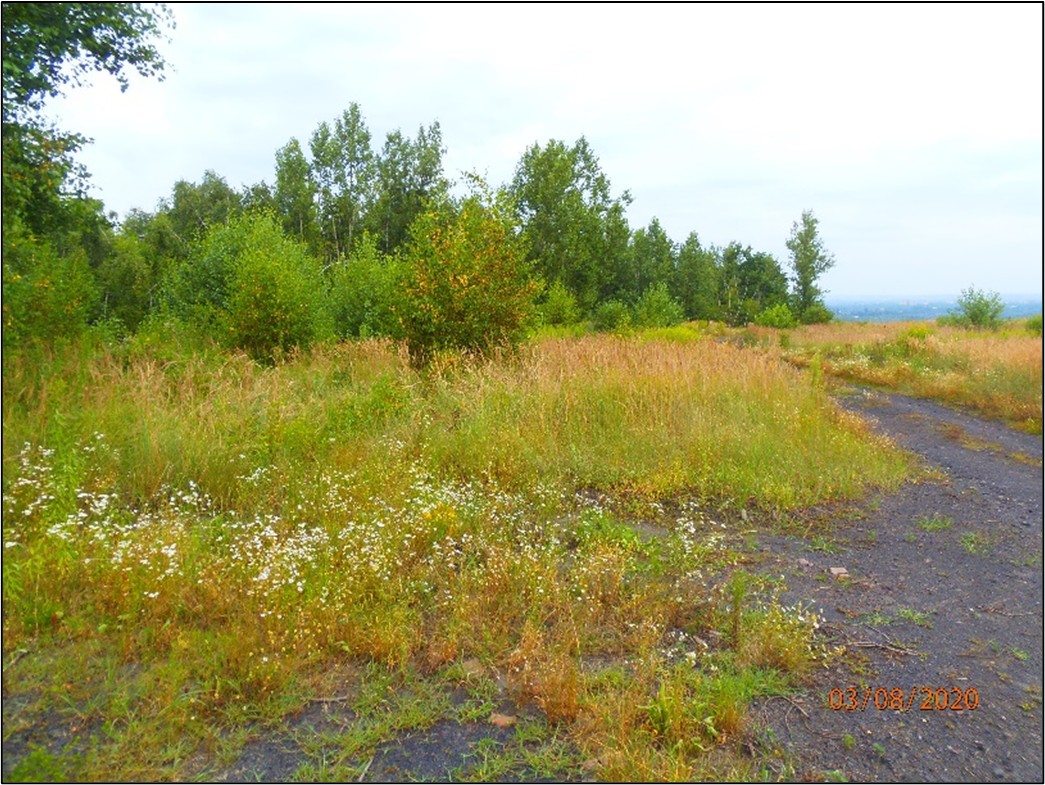
- The section at the southern foot was reclaimed by tree planting with debatable results. Approximately half of the central part of the waste dump is overgrown with self-seeded vegetation – trees, part of the upper plateau is overgrown with grasses. There is no fencing around the waste dump. Currently, the area of the central part of the waste dump is not being utilized in any way. The reclamation of the territory is closely related to the method of remediation of the thermal process on the waste dump. Visual examples are available for viewing in the gallery.
- History description
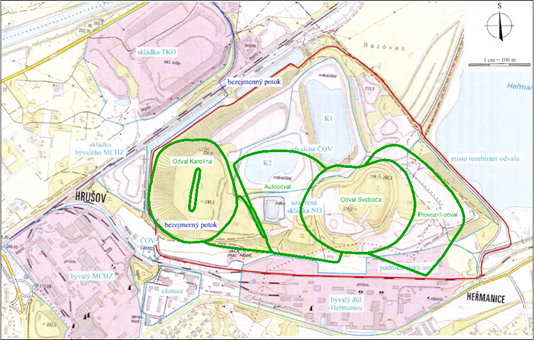
- From the perspective of the historical development of the entire Heřmanice dump, it can be stated that it originally consisted of two separate entities, which were connected only after 1976, thanks to extensive reclamation of the wider area. One entity was the Karolína dump located north of the former Ida Mine (later Rudý říjen 1 Mine – ventilation shaft). The Ida Mine was put into operation as early as 1838. The second entity is the Svoboda dump located north of the Heřmanice Mine (formerly Stalin Mine, Rudý říjen 2), which also incorporated the so-called auto-dump and operational dump. A diagram of the individual sections of the Heřmanice dump is shown in Figure 1 in the image gallery. The Heřmanice dump can be defined as the entire complex of all dumps in the area delimited by the Ostrava-Bohumín railway line, Heřmanický Pond, and the connection between the Ida and Heřmanice Mines from the commencement of the removal of the Karolína ridge dump and the construction of settling ponds north of the Svoboda dump and auto-dump after 1970. At that time, all parts were interconnected except for the operational dump, which continued to be operated, and only around 1990 was leveled with a gentle slope to the level of Heřmanický Pond into the shape of a flat table dump approximately 30 m thick. After 1970, construction of settling ponds began. The material for constructing the dams, composed of coal waste, came from development workings and preparations at the Heřmanice Mine. The dams are actually a continuation of the so-called auto-dump. In 1973, the removal of the Karolína dump cone began. The waste was transported by vehicles in western and northern directions and filled Hrušovský Pond. After filling the northern part of the pond, the transport of waste by trucks continued parallel to the Ostrava-Bohumín railway line. Transport during the removal of the cone also proceeded eastward toward the auto-dump. After 1976, further lowering of the elevation level of the Karolína ridge dump occurred. In 1978-1984, this waste was used for the construction of settling pond dams. At that time, the final removal of the Karolína ridge dump to the level of the auto-dump and their mutual connection took place. The slopes of this formation were modified and shaped in terraces. In the central part of the dump, reclamation activities were completed around 1985. After 1985, dump operations continued only in the northeastern area of the operational dump until the closure and liquidation of the Heřmanice Mine in 1990. In 2017, a homogenization processing line was built on the Heřmanice dump by Ostravská těžební a.s. The purpose of this processing line was to separate the extracted waste into waste aggregate and coal. Since 2020, the line has not been operated for economic reasons.
- Past waste rock usage
- Ano
- Usage description
- Construction projects: Burned coal waste Road I/67 Bohumín – Skřečoň (2009-2010) Road I/56 Ostrava – extended Místecká (2010)
- Material composition
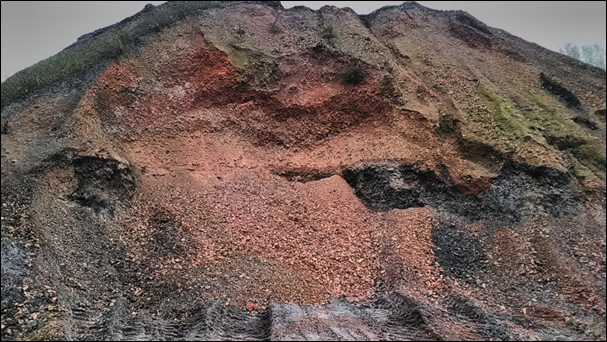
- The coal waste on the dump is composed predominantly of claystones in various stages of weathering (after deposition on the dump, relatively rapid grain disintegration occurs) approximately 40%, thermally transformed rocks (30%), and gray siltstones (30%). The proportion of sandstone fragments does not reach 5%. Thermal processes, unfortunately, do not cause uniform burn-through of the coal waste, and we often encounter positions/layers of unburned coal waste within burned waste, or zonal burning of rock fragments (see image gallery). This fact complicates the recommended selective extraction of these types of waste material. The content of combustible materials (determined by loss on ignition at 820°C) of samples from the dump depends on the character of the collected sample and in no way depends on the sample fraction. Only 1 g of the tested material is taken for the test. Results of combustible material content tests (loss on ignition values at 820°C according to ČSN ISO 1171) in coal waste samples from dumps (Kresta 2003): Sample Heřmanice A showed combustible material content of 22.5% for the 0-4 mm fraction, 34.0% for the 0-32 mm fraction, 30.5% for the 0-63 mm fraction, and 33.9% for the 0-125 mm fraction. Sample Heřmanice B showed combustible material content of 33.8% for the 0-4 mm fraction, 47.5% for the 0-32 mm fraction, 46.6% for the 0-63 mm fraction, and 32.1% for the 0-125 mm fraction. The coal that occurs on the Heřmanice dump originates from seams of the Ostrava Formation (Petřkovice, Hrušov, Jaklovec, and Poruba seams). Coalification increases with stratigraphic depth while simultaneously the ash content in the coal decreases. Coal from the coal waste deposited on the Heřmanice dump was obtained from a processing line. This was a unique procedure in the entire region. The processing line at the Heřmanice dump was the only line on all dumps in the OKR. The processing line is capable of processing approximately 350 tons of coal waste per hour, which represents up to 2 million tons annually. More detailed information regarding the quality of coal obtained from the line was not found from publicly available sources.
- Thermal activity status
- Thermally active
- Thermal activity description
- The Heřmanice dump has been thermally active for a long time. The first thermal manifestations on the surface were evident as early as 1990. Until the end of the 1990s, the situation was more or less stabilized, with barely noticeable signs of smoldering in the waste deposited in the conveyor route that led to the NNE cone and at the edges of the upper plateau of the cone. The development of smoldering from these areas occurred gradually from 1997, when the first signs of thermal activity appeared on the cone slope. At the beginning of 1998, ignition occurred in the cut of the access road leading to the southern terrace of the operational dump. In October 1998, further manifestations of developed fire occurred in the southern part of the operational dump, including open flames. The landowner urgently began the first necessary remediation works. In January 1999, the escape of combustion products was observed for the first time on the southern slope of the operational dump above the gas pipeline. Gradually, the fire also affected almost the entire southern part of the cone. In 2003, the area of less thick waste positions beneath the foot of the southern terrace – the scrap yard area and adjacent private properties – was more significantly affected, burning intensively to this day. Locally, thermal activity subsided. In 2004, the expansion of the fire into the railway siding area was detected and extensive remediation was carried out using a separating injection wall. In 2005, a hotspot at the western foot of the cone (in the section called auto-dump) was demonstrably verified. Thermal processes continued migrating westward. In 2020-2021, the hotspots of thermal activity are concentrated in the eastern part of the dump, including the summit and eastern slope, and on the northeastern dam of the former settling pond.
- Thermal monitoring
- Ano
- Monitoring description
- Here's the translation from Czech to English: "According to available materials, several independent phases of thermal monitoring were implemented at the Heřmanice dump site: a) Measurements conducted by VVUÚ Ostrava-Radvanice on the upper surface of the NNE truncated cone of the Svoboda dump around 1990. Individual thermometric probes (tubes manually driven to shallow depth) were distributed more or less chaotically in locations of surface smoldering manifestations. Temperature measurement results were not found. These locations of surface smoldering manifestations were visible, though without burning of grass cover or trees, even in 1997, when further measurements were conducted by DPB Paskov company. b) Green Gas DPB Paskov a.s. measurements in 1997 on the upper plateau of the NNE truncated cone of the Svoboda dump and along the route of the decommissioned conveyor (cable car) demonstrated progression and spread of smoldering from the cable car further along the edge of the southern slope toward the east. c) Green Gas DPB Paskov a.s. measurements at the cut locations beneath the foot of the NNE cone of the Svoboda dump east of the conveyor route were performed as part of immediate verification of conditions at the time of open flame manifestation on the surface. d) In 1998, measurements were conducted by VVUÚ Ostrava at the boundary of the cone foot above the level of the remediated operational dump - southern terrace to verify the effectiveness of fly ash filling. e) In October 1998, manifestations of developed fire occurred on the operational dump – southern terrace (at a distance of approximately 60 m from the medium-pressure gas pipeline), including open flames in volunteer trees, and surface and subsurface thermometric measurements were conducted. In January 1999, the escape of combustion products from the southern terrace dump slope above the gas pipeline was observed for the first time. This fact led to the initiation of thermometric monitoring of the surroundings of the potentially threatened gas pipeline section in connection with its protection. In the subsequent period, the scope of monitoring changed depending on the spread of smoldering. f) In 2003, exploration and monitoring of thermal processes was initiated by SG Geotechnika a.s. g) In 2004-2006, monitoring of the fire that developed in the railway siding area was conducted. h) In 2007-2008, exploration and monitoring of thermal processes was conducted on Area II located west of the first systematic monitoring. At the time of its completion, temperature measurements were also performed in the originally long-term monitored area. From the above, it is evident that monitoring of thermal processes from the observation of the first manifestations around 1990 until 2004 was not conducted systematically. Random measurements were performed mostly based on the detection of additional hotspots and usually when financial resources were allocated for them. From this perspective, the development of thermal activity in the affected area in the period before 2004 cannot be fully objectively evaluated. It can only be stated that thermal activity from 1990, when the first signs were observed on a small area of the Svoboda dump cone, progressed very dynamically until it affected the entire cone, the entire southern and southeastern terrace area, and advanced beneath the access road and through the business premises to the railway siding area. The next phase of thermal monitoring took place only in 2020 and subsequently in 2021. Since 2021, the development of thermal activity has been monitored continuously in four boreholes. Thermal monitoring is currently conducted by DIAMO s.p. with its own resources. Continuous temperature measurements are provided by SG Geotechnika together with FEI VŠB-TU Ostrava. Results are available at DIAMO s.p.
- Recommendations - testing
- Coal waste tests – so-called pot tests of coal waste on the dump are recommended (see Kresta – Martinec 2025).
- Recommendations - monitoring
- Thermal monitoring – recommend minimum scope and frequency of monitoring. It is recommended to establish a network of monitoring thermometric boreholes in several lines across the dump from the thermally active part toward the constructed separating air barrier (OVS A). Another line should be established directly in the separating air barrier (OVS A). This will make it possible to respond appropriately to any temperature increase in the boreholes and potentially carry out local intervention.
- Remediation proposal
- Recommendation of an appropriate procedure for thermal process remediation with regard to the specific conditions of the dump. Remediation of the Heřmanice dump has been discussed at least since 2020, when a remediation and reclamation project was developed by PROB a.s. company. The project was not implemented. In 2024, a multi-criteria analysis of the feasibility study of individual remediation methods was prepared, from which the variant of closing the entire dump into a "sarcophagus" using primarily fluid fly ash was recommended. The zero variant, i.e., long-term monitoring of the area and local remediation in locations that would be identified as high-risk by monitoring, was not accepted. I still hold the opinion that the zero variant is the most suitable method for long-term management of thermal activity at the Heřmanice dump.
Kresta F. (2003): FD-K/047 Minimalizace negativních důsledků v energetické činnosti. Racionální využití kameniva z odvalů uhelných ložisek. Souhrnná závěrečná zpráva. MS Stavební geologie – Geotechnika a.s., 12/2003.
Kresta F., Hájovský J. (2020): Klasifikace odvalů po těžbě uhlí (ÚMTO) na Ostravsku a Karvinsku. MS SG Geotechnika a.s., 09/2020.
Kresta F., Hájovský R. (2021): ÚMTO Heřmanice, kontinuální termický monitoring. Závěrečná zpráva o monitoringu v roce 2021. MS SG Geotechnika a.s., 12/2021.
Kresta F., Martinec P. (2015): Termické procesy v odvalech uhelné hlušiny. VŠB Technická univerzita Ostrava, 2025. 234 s., ISBN 978-80-248-4830-3
Štancl L. (2024): Multikriteriální analýza variant sanace ÚMTO Heřmanice. AZ Geo s.r.o., 2024.
Information data quality:
High – On-site measurements, official documentation, professional studies, drone/UAV surveys, laboratory analysis, direct interviews, government databases
Geometric data accuracy:
High – GPS/GNSS field survey (RTK/PPK), drone survey, LiDAR scanning, cadastral survey, total station