Thermally active
Coal heap (contains coal remains)
32.00
ha
8.00
mil. m³
1920 - 1995
Period
Layers
- Land use plan
- According to the Land Use Plan of the City of Ostrava (map portal as of 14.8.2020), the Ema spoil heap area is designated as areas with differing uses: industrial waste dump – reclamation, forest. The Ema spoil heap falls within the territorial system of ecological stability, category local biocentre MBC111. On the NW boundary of the spoil heap, a change of land use is anticipated (housing, civic amenities, industrial waste dump, reclamation), conditional on decontamination. The intended land use is not in conflict with the current state. The greater part of the spoil heap will undergo technical reclamation. In the part designated for decontamination and change of use (housing, civic amenities), the risk of the onset and development of a thermal process must be eliminated. Technical measures must be derived from thermal monitoring and its evaluation. Past intentions to build a lookout tower on the crown of the Ema spoil heap, or a terminal station of a cableway from the Lower Vítkovice Area, have not yet been incorporated into the land use plan.
| Heap part | Cadastral unit | Parcels | Owner |
|---|---|---|---|
| Ema | Slezská Ostrava (714828) | 510/1, 510/2, 510/4, 2413 | Asental Land, s.r.o., Gregorova 2582/3, Moravská Ostrava, 70200 Ostrava |
Ema
- Volume
- 8.00 mil. m³
- Area
- 32.00 ha
- Period
- 1920 - 1995
- Transport technology
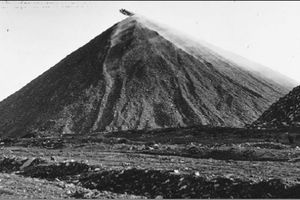
- Narrow-gauge track, a ring around Ema for cars and tractors/haulers. Ema [reached] by skip lift along the incline, by cableway from the Trojice Mine. A conical shape with an irregular tabular (flat) area at the base of the cone.
- Heap status
- Inactive
- Status description
- Inactive, partially reclaimed
- Reclamation
- Partially reclaimed
- Reclamation description
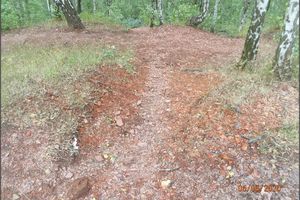
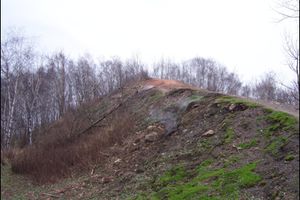
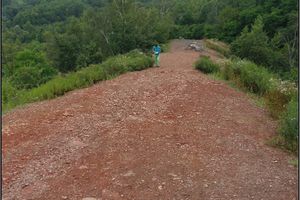
- To date, reclamation has been carried out on the peripheral ring of the Ema spoil heap: flattening of the slopes and afforestation, including soil cover on the crown as well. Volunteer (self-seeded) vegetation, predominantly birches, occurs on the crown. The area of the former discharge boom/conveyor is without vegetation. The area of interest of the Ema spoil heap is not fenced.
- History description
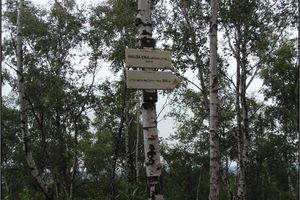
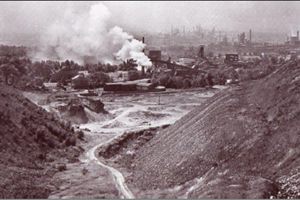
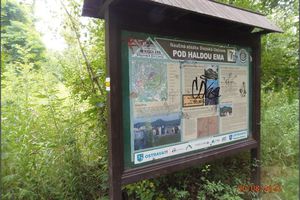
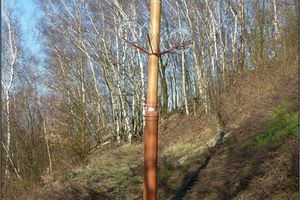
- The Ema spoil heap forms a complex of spoil heaps of the former Ema, Trojice, and Petr Bezruč (Terezie) mines and other historically older mine workings. It is one of the oldest spoil heaps in the Ostrava region, which has been in operation since 1920. Morphologically, it is a slope-type spoil heap combined with a conical spoil heap. The slope of the heap is developed only partially, since its deposition took place gradually, following partial terrain modifications of the original subsoil. The original configuration of the terrain surface can no longer be determined today. Given that the extraction of quality coal seams was originally carried out mainly by hand, the percentage of deposited waste rock was not very large in the past. With the gradual mechanization of mining, the volume of deposited material increased. The basic processing of the mined raw coal consisted, in the first phase, of screening on a grate with an 80 mm mesh. The oversize fraction passed over a manual picking belt and then, together with the undersize fraction (below 80 mm), went to a cableway lift to the processing plant of the Karolina coking plant. Selected stone from the picking belt was stored in a bunker and then transported by wagons via a narrow-gauge track to a wagon lift onto the Ema spoil heap, from where it was deposited on the heap by a THV 15 tank tippler. The Ema spoil heap is located in an area with a long history of mining use. The presence of old workings and a number of mine workings in its subsoil allows for the possibility of communication (connection) between them and the spoil heap. Apart from ordinary Carboniferous rocks, an undetermined quantity of construction, municipal, and household waste was also deposited there. Immediately after World War II, rubble from bombed-out houses was deposited at the foot of the heap. According to the testimony of contemporary witnesses, wood shavings were also dumped on the heap, and washery tailings (rejects) with a grain size of 0/200 were deposited there, which in places represent about 15% of the volume. A tourist trail marker (nature/educational trail) leads to the top of the central cone (Figure 5). The site of the central cone of the Ema spoil heap is a technical monument.
- Material composition
- Waste rock from development work, drivage, and processing plants – state the specific mine from which the coal waste rock was deposited, add the proportion of the main rock components, and if applicable the content of coal matter or combustible substances (and by which methodology it was determined). The Ema spoil heap consists for the most part of burnt-out (scorched) coal waste rock. The coal waste rock from the Ema spoil heap was not mined/extracted in the past and was not used for construction purposes. Likewise, no laboratory tests of coal waste rock samples from the Ema spoil heap have yet been carried out to verify their physical-mechanical properties. The original coal waste rock came from the mining of the Hrušov and Petřkovice beds/seams, i.e. rocks with the highest degree of coalification in the Ostrava part of the OKR (Ostrava-Karviná Coal District).
- Thermal activity status
- Thermally active
- Thermal activity description
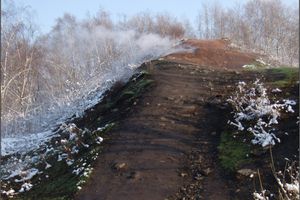
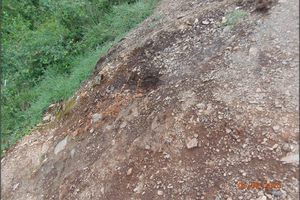
- Thermal processes in the Ema spoil heap, including open fires, have been ongoing for decades with varying intensity. Repeated attempts to remediate the central cone have not been effective. In the 1960s, an operational trial of remediating existing thermal processes, combined with prevention of the formation of new sites of thermal activity, was carried out. It consisted of jointly depositing coal waste rock and power-plant fly ash. A technological line was created in which the two materials were mixed together; this line also included a fly-ash dump located outside the crown of the spoil heap, enclosed by a dike made of mine waste rock 2.5–3.0 m high. The fly ash had to be sprinkled with water when it dried out, and spent stillage (distillery residue) from the Vratimov paper mills was also tested for this purpose. After mixing, the material was transported in mine cars to the spoil heap, where it was tipped out. This operational trial was characterized by a number of drawbacks. Separation of the materials occurred during tipping, whereby larger and heavier pieces slid down to the foot of the cone while the fly ash reached only about a quarter of the way up the slope. Due to precipitation, the fly ash was subsequently washed away, leading to slope deformations. The Ema site was also negatively affected by its close connection to the adjacent spoil heap of the Trojice mine, where spontaneous combustion and a subsequent fire evidently occurred owing to the high content of combustible substances in the waste rock. The Trojice spoil heap was remediated in 1977. The remediation technology chosen was the method of areal trenching (furrowing) of the heap's surface. A suspension of power-plant fly ash and water was flushed into the excavated trenches. In this way, a sealing barrier was created against the spread of the fire to the neighboring Ema spoil heap. Also significant was the resolution of a smoldering (hot spot) event on the northwest slope of the heap, where there was a risk of possible spread to the old spoil heap on the grounds of the Petr Bezruč mine. This problem was addressed in 1982 by the OKD emergency commission. A method of depositing insulating strips on the slope of the heap was proposed and implemented. The technological procedure consisted of the regular deposition of power-plant fly ash in layers, subsequently covered by a layer of processing-plant tailings with a guaranteed and controlled content of combustible substances. In this way, an insulating partition was created between the old spoil heap and the Ema spoil heap. Following the remediation intervention, reclamation was carried out in this section. Thermal processes in the spoil heap currently occur on the southwest part of the slope of the central cone, in a strip 7–12 m wide (the area of the former cableway). The affected part has an area of approximately 2000 m² and contains open vents emitting hot gaseous combustion products.
- Thermal monitoring
- Ano
- Monitoring description
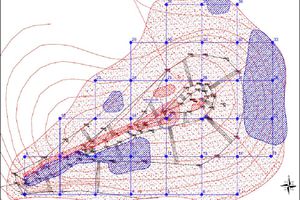
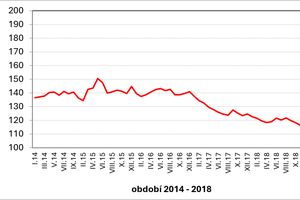
- Thermal monitoring at the Ema spoil heap was carried out during the period 2007–2009 (Hájovský 2009), and subsequently, together with monitoring of the Hedvika spoil heap, during the period 2013–2018 (Kresta – Hájovský 2018). Within the first stage (2007–2009), among other things, surface mapping of the spoil heap was carried out and the extent of thermally altered and unaltered materials on the surface was refined/specified (Figure 6). Repeated aerial thermal-imaging (thermovision) surveys over the monitored period did not demonstrate any migration of thermal activity manifesting on the surface of the spoil heap. During the years 2014–2018, no significant changes in thermal activity occurred at the Ema spoil heap site. The more thermally active area is in the vicinity of boreholes/probes D-1, D-3, E-18, E-19 in the upper part of the former discharge boom/conveyor. The second, less active area is located in the lower part of the boom, in the vicinity of probes E-46 and E-9. During 2014–2018, a slight decrease in temperature was recorded in the probes with higher thermal activity. The long-term temperature trend in probe D-1 is shown in Figure 7. During the period 2014–2018, in addition to thermal monitoring, regular quarterly measurements of the concentrations of selected gases (CO, NOx, benzene) were also carried out at three levels (at the surface, 20 cm above the surface, and 1 m above the ground surface). The presumed relationship between decreasing gas concentration in the air and increasing height above the terrain was not unambiguously confirmed. Compared with the permitted concentration for mine gases, the limit for CO concentration (30 ppm) and for NOx (7.6 ppm) was not exceeded in the measured samples at any measurement date, monitoring point, or sampling level.
- Recommendations - testing
- Coal waste rock testing – basic tests to verify physical-mechanical properties, as well as loss-on-ignition tests, and possibly so-called "pot tests" (crucible/pot tests) of coal waste rock on the spoil heap, are recommended (see Kresta – Martinec 2025).
- Recommendations - monitoring
- We recommend carrying out regular thermal monitoring at the spoil heap, which will make it possible to optimize the use of the area and protect its visitors.
- Remediation proposal
- Recommendation of a suitable procedure for remediation of the thermal process with regard to the specific conditions of the spoil heap. Remediation of the Ema spoil heap is not currently under consideration. It is recommended to continue monitoring.
Hájovský J. (2009): Odval EMA – průzkum a monitoring termických procesů. Závěrečná zpráva. ARCADIS Geotechnika a.s., 06/2009.
Kresta F. (2003): Obsah spalitelných látek a náchylnost k samovznícení hlušinové sypaniny, Geotechnika, 1, 2003, str. 7-12, 2003.
Kresta F. (2010): RRC/04/2010 Studie proveditelnosti sanace centrálního kužele odvalu Ema zasaženého podzemním požárem. Závěrečná zpráva. ARCADIS Geotechnika a.s., 2012.
Kresta F, Hájovský J. (2010): Long-term temperature monitoring of the Ema tip in Ostrava (Czech republic). Proceedings of the 2nd International Conference on Coal Fire Research (ICCFR2), Berlin, 2010.
Kresta F., Hájovský J. (2011): FR-TI1/307 Výzkum termických procesů odvalů vzniklých při těžbě uhelných ložisek, vývoj metod a zařízení pro využití jejich termického potenciálu. Etapa X Pasportizace odvalů. Závěrečná zpráva. ARCADIS Geotechnika a.s., 01/2011.
Kresta F., Hájovský J .(2018): Monitoring úložných míst těžebního odpadu – odvaly Hedvika a Ema. Závěrečná zpráva o monitoring za období 2014-20418. SG Geotechnika a.s. 2018
Kresta F., Hájovský J. (2020): Klasifikace odvalů po těžbě uhlí (ÚMTO) na Ostravsku a Karvinsku. MS SG Geotechnika a.s., 09/2020.
Kresta F., Martinec P. (2015): Termické procesy v odvalech uhelné hlušiny. VŠB Technická univerzita Ostrava, 202. 234 s., ISBN 978-80-248-4830-3
Schulhauserová R. (2015): Potenciál Brownfields z pohledu zahradně krajinářského architekta, bakalářská práce, Mendelova univerzita v Brně. 2015.
Information data quality:
High – On-site measurements, official documentation, professional studies, drone/UAV surveys, laboratory analysis, direct interviews, government databases
Geometric data accuracy:
High – GPS/GNSS field survey (RTK/PPK), drone survey, LiDAR scanning, cadastral survey, total station