Hedvika
Thermally active
Coal heap (contains coal remains)
32.00
ha
40.0
m height
4.20
mil. m³
unknown - 1998
Period
Layers
- Land use plan
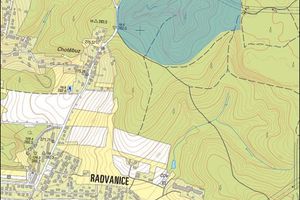
- According to the Land Use Plan of the City of Ostrava (map portal as of 14.8.2020), the area of the Hedvika spoil heap is designated as areas with differing uses, forests. The Hedvika spoil heap is part of the territorial system of ecological stability, category local biocentre MBC 4-11, supraregional biocorridor NRBK 4-12, and NRBK 4-10. The intended land use is not in conflict with the current state. The Hedvika spoil heap will be afforested.
| Heap part | Cadastral unit | Parcels | Owner |
|---|---|---|---|
| Hedvika | Radvanice (715018) | 866/1, 871/1, 868, 867/1,857/5, 864/1, 863/1, 862/1, 861, 865/2, 865/3, 859/1 | Česká republika, Lesy České republiky, s.p., Přemyslova 1106/19, Nový Hradec Králové, 50008 Hradec Králové |
| Hedvika | Radvanice (715018) | 865/1, 863/2 | DIAMO, státní podnik, Máchova 201, 47127 Stráž pod Ralskem |
Hedvika
- Volume
- 4.20 mil. m³
- Area
- 32.00 ha
- Max. height
- 40.0 m
- Period
- unknown - 1998
- Transport technology
- Mine wagons.
- Storage technology
- Gradual dumping/tipping into the valley system.
- Heap status
- Inactive
- Status description
- Inactive, partially reclaimed.
- Reclamation
- Partially reclaimed
- Reclamation description
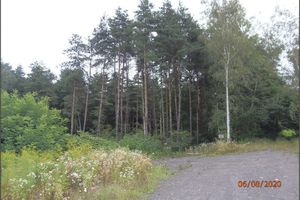
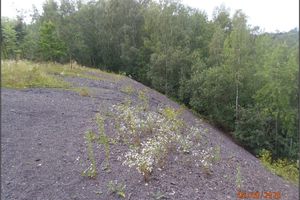
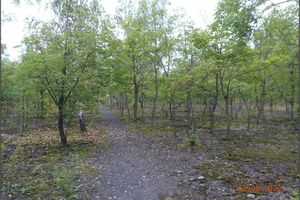
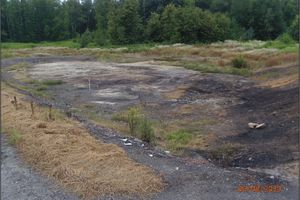
- During the period 1966–1971, extensive reclamation works were carried out. The northeastern edge of the spoil heap was leveled/shaped into its present-day form, parallel to the Michálkovice – Petřvald road, as was the southern part of the spoil heap behind the football pitch. The last activity on the spoil heap in 1971 took place in its northwestern part. This involved further excavation and extinguishing of the burning part of the spoil heap, followed by leveling/adjustment into its final shape. A part of the northwestern area of the Hedvika spoil heap was reclaimed in the past by planting trees, which is now supplemented by volunteer (self-seeded) vegetation predominantly of birches (Figure 5). Most of the spoil heap is overgrown with volunteer vegetation. There is no fencing around the spoil heap. Currently, the area of the spoil heap is not utilized. The local paths are occasionally used by cyclists. On the eastern side, the spoil heap has not yet been affected by thermal processes.
- History description
- The exact date of establishment of the Hedvika spoil heap is not known. It is assumed that spoil rock has been deposited here since as early as 1903, originating from shaft-sinking and opening-up (development) workings. The oldest parts are located in the vicinity of the former mine plant complex. As the volume of extraction increased, the spoil heap expanded in a northwesterly direction toward the built-up area of Michálkovice. Transport of waste rock to the spoil heap was carried out by mine tubs (mine cars). In 1947, the deposition of coal waste rock took place mainly in the direction north and west of the Hedvika Mine complex. Toward the north, the slope of the spoil heap gradually approached the Hedvika 2 – Výdušná shaft. The main transport routes at that time ran in a northwesterly direction and along the complex in a northeasterly direction, which then curved toward the north. In 1949, the spoil heap expanded in its central part to the northwest, precisely along the axis of the morphological depression. The transport routes and method were the same as in the previous period. The elevation of the spoil heap reached approximately 270 m above sea level. In 1957, the first fire of deposited coal waste rock on the spoil heap was recorded. According to oral information, it was extinguished on site by relocation and dousing. In 1961, the deposition of coal waste rock continued generally to the west and northwest, in the direction of the morphological depression. In this direction, the waste rock material was transported by mine cars. Toward the north, to the area of the Hedvika 2 – Výdušná shaft, waste rock was at that time transported by trucks, and the spoil heap expanded as far as beyond the Hedvika 2 – Výdušná shaft. During the period 1961–1964, the deposition of coal waste rock intensified. Toward the north, dumping from mine cars resumed, and transport by trucks also continued. The spoil heap expanded toward the Michálkovice – Petřvald road. Toward the northwest, deposition of coal waste rock continued using mine cars, and the spoil heap's footprint reached as far as the small ponds in Michálkovice. To the west of the Hedvika Mine (behind the football pitch), a further part of the Velký les (Great Forest) was cleared, and the spoil heap expanded in this direction as well. During the period 1966–1971, extensive reclamation works were carried out. The northeastern edge of the spoil heap was leveled into its present-day form, parallel to the Michálkovice – Petřvald road, as was the southern part of the spoil heap behind the football pitch. The last activity on the spoil heap in 1971 took place in its northwestern part. This involved further excavation and extinguishing of the burning part of the spoil heap, followed by leveling into its final shape. The spoil heap is administered by DIAMO s.p. Currently, the plots of land on which the spoil heap is located are for the most part owned by Lesy České republiky (Forests of the Czech Republic), with a smaller part belonging to DIAMO s.p.
- Material composition
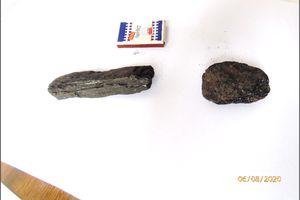
- Waste rock from development work, drivage, and processing plants – state the specific mine from which the coal waste rock was deposited, add the proportion of the main rock components, and if applicable the content of coal matter or combustible substances (and by which methodology it was determined). The coal waste rock at the Hedvika spoil heap originates from the seams of the Ostrava Formation (Petřkovice, Hrušov, Jaklovec, and Poruba beds/layers). The degree of coalification increases with stratigraphic depth, while at the same time the ash content in the coal decreases. In addition to fragments of coal, rocks with disseminated coal matter (carbonaceous claystone/coal claystone) also occur abundantly on the spoil heap. The content of combustible substances in samples taken from boreholes for the installation of thermometric probes in 2003 reached values of 11.75–20.68% (Kresta – Hájovský 2006). On the other hand, when analyzing borehole samples for thermal monitoring at the Canis Safety a.s. facility in 2013, contents higher than 30% were found. Further laboratory tests of coal waste rock samples to verify their physical-mechanical properties have not been carried out.
- Thermal activity status
- Thermally active
- Thermal activity description
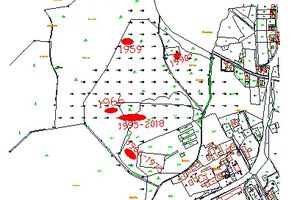
- Thermal processes at the Hedvika spoil heap site have been recorded continuously since the end of the 1950s. Initially, a smoldering (self-heating) process was observed in the northern part of the spoil heap, which turned into an underground fire in 1959. Its activation and intensive spread occurred in 1960 following the application of an unsuitable technology for creating separating trenches (using blasting works). Further foci appeared on the area of the spoil heap around the mid-1960s, namely in the southern part of the spoil heap near the Hedvika Mine complex and in the western part. In the 1990s, two areas with thermal activity were localized: the first in close proximity to the old Hedvika 2 – Výdušná shaft, the second in the central part of the spoil heap. The sites with thermal activity are shown in Figure 7. Currently, the central part remains thermally active, and as part of long-term monitoring it has been confirmed that the thermal processes have spread toward the business/commercial complex established on the site of the former Hedvika Mine. Remediation interventions at the Hedvika spoil heap From the available information, it emerged that historically the first larger-scale remediation was the excavation/removal of a smoldering focus (fire hotspot) in the northwestern part of the spoil heap and the backfilling of the resulting space with new waste rock (after 1983). In the southern part of the spoil heap, the foci that had formed were gradually eliminated by covering them with insulating layers and subsequently reshaping with waste rock. The central part was also remediated in the 1990s by covering with insulating layers, including fly ash. The last stage of the trial remediation of local foci (insulation and inertization) was the flooding of thermally active discontinuities with a liquid clay mixture.
- Thermal monitoring
- Ano
- Monitoring description
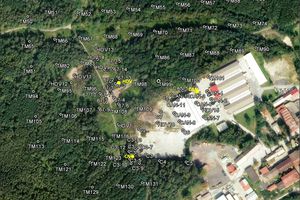
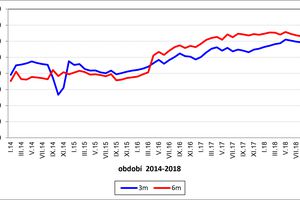
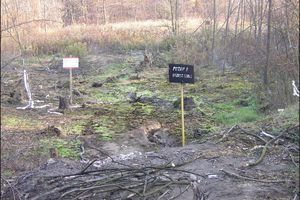
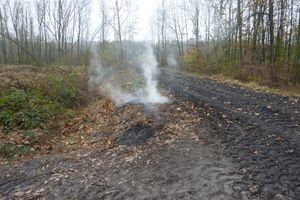
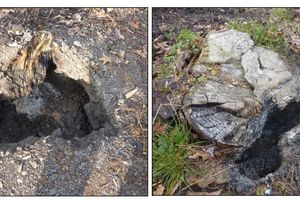
- Temperature monitoring (unknown technical implementation) took place as early as 1966 in the southern part of the spoil heap, west of the football pitch. The maximum temperatures found at that time (up to approximately 400°C) testified to considerable intensity of thermal processes. Further temperature measurements (subsurface – at measurement profiles and in measurement boreholes) took place in the central part and in the area near the old Hedvika 2 – Výdušná shaft during the period 1995–1998 (measurements were carried out by VVUÚ a.s. Ostrava during 1995–1996, subsequently by DPB Paskov during 1997–1998). At that time, maximum temperatures of up to 450°C were recorded. During the period 2003–2018, continuous monitoring of thermal processes took place at the Hedvika spoil heap, and in the last stage (2013–2018) also monitoring of hazardous gas emissions. During 2003–2006, survey and monitoring of thermal processes was carried out by the company SG Geotechnika a.s. (in cooperation with DPB Paskov). During 2008–2013, monitoring of thermal processes was carried out by the company SG Geotechnika a.s. (in cooperation with DPB Paskov). During 2013–2018, monitoring of thermal processes and gas emissions at the spoil heap was carried out by the company SG Geotechnika a.s. (in cooperation with DPB Paskov). During the course of monitoring, 3 distinct foci of thermal activity were localized at the Hedvika spoil heap. At the first site, in the vicinity of probes HDV 6, TM 97, 67-10, the highest thermal activity has been manifesting since the beginning of 2014. Temperatures here were higher than 400°C throughout the entire five years of thermal monitoring (up to 12/2018). Since June 2016, another partial focus of thermal processes has visually manifested to the northeast of the first site. In July 2016, thermometric probes designated N1–N10 were installed there. High thermal activity was confirmed in the vicinity of probe N4. Temperatures throughout the entire period up to December 2018 exceeded 300°C. In the 4th quarter of 2018, a significant increase in temperatures occurred in probe N6, reaching a value of 309°C. Overall, during the period 2014–2018, the site expanded thermally in a northeasterly direction. The thermal processes, in terms of the persistence of a single deposit, can be assessed as partially variable. The second site, in the vicinity of storage halls No. 10, No. 11, and No. 12 of the company Canis Safety a.s., is relatively stable, with gradually decreasing temperatures. An exception is the area near the southern side of storage hall No. 10 and in the vicinity of the new building completed during 2018, where temperatures even exceeding 200°C currently occur. The increase in thermal activity evidently relates to excavation works on the new building in the immediate vicinity of these probes. During July 2017, a new focus of thermal processes arose between probes TM 88 and TM 100. During the following months (August–December 2017), the focus spread along the embankment of the local access road, which manifested itself through the emission of smoke, an aromatic odor, and high temperatures of up to 778°C at a depth level of approximately 200 mm below the surface. During 2018, this focus then subsided significantly. In the 3rd quarter of 2018, a sharp increase in temperatures occurred in probe TM 88, up to a value of 179°C. Due to the destruction of this probe in September 2018, it was no longer possible to monitor thermal activity in it further. Given the surrounding probes and the absence of smoke emission, a decline in thermal activity can be assumed in this area. At the third site, in the vicinity of probe C3-10, a gradual slow decline in thermal activity occurred during 2014–2018. The condition at this site is stabilized and is approaching the boundary of natural temperature background. Overall, thermal activity can be assessed, from a long-term perspective, as relatively dynamic at the first and second sites, and as stable with a slight decline in thermal activity at the third site. During the period 2014–2018, in addition to thermal monitoring, regular quarterly measurements of the concentrations of selected gases (CO, NOx, benzene) were also carried out at three levels (at the surface, 20 cm above the surface, and 1 m above the ground surface). Measurements were carried out at two probes. The presumed relationship between decreasing gas concentration in the air and increasing height above the terrain was not unambiguously confirmed. Compared with the permitted concentration for mine gases, the limit for CO concentration (30 ppm) and for NOx (7.6 ppm) was not exceeded in the measured samples at any measurement date, monitoring point, or sampling level.
- Recommendations - testing
- Coal waste rock testing – so-called "pot tests" (crucible/pot tests) of coal waste rock at the spoil heap are recommended (see Kresta – Martinec 2025).
- Recommendations - monitoring
- We recommend continuing thermal monitoring at the spoil heap and eliminating potential threats of underground fires, which may turn into surface fires.
- Remediation proposal
- Recommendation of a suitable procedure for remediation of the thermal process with regard to the specific conditions of the spoil heap Remediation of the Hedvika spoil heap is not currently under consideration. It is recommended to continue monitoring and to carry out gradual reclamation of the spoil heap.
Hájovský J. (2013): Dlouhodobý monitoring termické aktivity odvalu Hedvika. Závěrečná zpráva. ARCADIS CZ a.s. 2013.
Kresta F. (2003): Obsah spalitelných látek a náchylnost k samovznícení hlušinové sypaniny, Geotechnika, 1, 2003, str. 7-12, 2003.
Kresta F. (2012): Druhotné suroviny v dopravním stavitelství. VŠB TU Ostrava, 142 s., 2012.
Kresta F., Hájovský J.(2006): Odval Hedvika – průzkum a monitoring termických procesů. Závěrečná zpráva. SG Geotechnika a.s., 12/2006.
Kresta F., Hájovský J. (2011): FR-TI1/307 Výzkum termických procesů odvalů vzniklých při těžbě uhelných ložisek, vývoj metod a zařízení pro využití jejich termického potenciálu. Etapa X Pasportizace odvalů. Závěrečná zpráva. ARCADIS Geotechnika a.s., 01/2011.
Kresta F., Hájovský J. (2018): Monitoring úložných míst těžebního odpadu – odvaly Hedvika a Ema. Závěrečná zpráva. SG Geotechnika a.s., 12/2018
Kresta F., Hájovský J. (2020): Klasifikace odvalů po těžbě uhlí (ÚMTO) na Ostravsku a Karvinsku. MS SG Geotechnika a.s., 09/2020.
Kresta F., Martinec P. (2025): Termické procesy v odvalech uhelné hlušiny. VŠB Technická univerzita Ostrava, 2025. 234 s., ISBN 978-80-248-4830-3
Information data quality:
High – On-site measurements, official documentation, professional studies, drone/UAV surveys, laboratory analysis, direct interviews, government databases
Geometric data accuracy:
High – GPS/GNSS field survey (RTK/PPK), drone survey, LiDAR scanning, cadastral survey, total station