Stachanov
Thermally inactive
Coal heap (contains coal remains)
3.00
ha
28.0
m height
0.40
mil. m³
1933 - 1938
Period
Layers
- Land use plan
- According to the Land Use Plan of the City of Ostrava (map portal as of 14.8.2020), the area of the Stachanov spoil heap is designated as areas with differing uses: light industry, redevelopment areas, areas to be examined by a territorial (land-use) study. For the intended land use, decontamination must be carried out at the foot of the spoil heap and its surroundings (removal of illegal dumps).
| Heap part | Cadastral unit | Parcels | Owner |
|---|---|---|---|
| Stachanov | Hrušov (714917) | 645, 590/1 | Asental Land, s.r.o., Gregorova 2582/3, Moravská Ostrava, 70200 Ostrava |
Stachanov
- Volume
- 0.40 mil. m³
- Area
- 3.00 ha
- Max. height
- 28.0 m
- Period
- 1933 - 1938
- Heap status
- Inactive
- Status description
- Inactive, not reclaimed
- Reclamation
- No reclamation
- Reclamation description
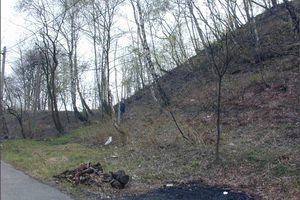
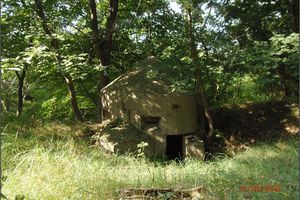
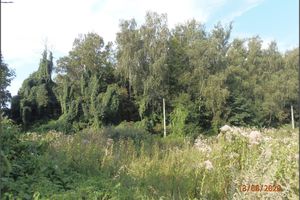
- The Stachanov spoil heap has not been reclaimed in the past. It is covered with dense vegetation. On the crown of the spoil heap there is an old military structure. In the immediate vicinity of the spoil heap there is an old, abandoned/derelict building.
- History description
- The Stachanov spoil heap was established in 1933 for depositing mined waste rock from the opening-up works of the then Masaryk 2 Mine. It was used only until 1938. The technology consisted of depositing material in layers using hoists along the incline, a tank tippler, and cable-suspended containers (koliba). It is a typical example of a conical spoil heap of elongated truncated shape in the east-west direction, with one terrace at its southern foot. Currently, the entire body of the spoil heap is covered with extensive growth and woody vegetation of various volunteer (self-seeded) origin. At the northern foot of the spoil heap, particularly in the area of devastated/derelict garages, illegal dumps are found.
- Material composition
- The mine waste rock contains a variable amount of coal matter, either disseminated or deposited in thin layers/laminae. Coal of the Hrušov beds of the Ostrava Formation predominates here. The coal waste rock deposited at the Stachanov spoil heap was not affected by thermal activity. The grain size of the unburnt coal waste rock at the spoil heap reaches up to 300 mm. Coal waste rock was not mined/extracted at the Stachanov spoil heap in the past, and no laboratory tests of the physical-mechanical properties of the waste rock have been carried out here. The content of combustible substances in the coal waste rock was variable and reached up to 23.9% (Kresta – Hájovský 2011).
- Thermal activity status
- Thermally inactive
- Thermal activity description
- No thermal activity has been observed at the Stachanov spoil heap throughout its existence. The concentration of CO, as a basic indicator of the incomplete combustion process, was zero during measurements in 2010. Thermal measurements in 2010 showed a normal temperature (8.5°C) at a depth of 1 m below the ground surface, which corresponds to normal background temperature. Despite the higher content of combustible substances in the coal waste rock (23.9%), the risk of the development of thermal activity is low (Kresta – Hájovský 2011). No manifestations of thermal activity were found at the Stachanov spoil heap in August 2020.
- Thermal monitoring
- Ano
- Monitoring description
- Thermal measurements in 2010 showed a normal temperature (8.5°C) at a depth of 1 m below the ground surface, which corresponds to normal background temperature. Despite the higher content of combustible substances in the coal waste rock (23.9%), the risk of the development of thermal activity is low (Kresta – Hájovský 2011). As part of the next stage of work, we recommend carrying out one round of thermal monitoring at the site.
- Recommendations - testing
- Basic tests of coal waste rock are recommended, including determination of loss on ignition.
- Recommendations - monitoring
- A one-time (single) stage of thermal monitoring using aerial imaging/surveying is recommended.
- Remediation proposal
- For the time being, only thermal monitoring is proposed.
Kresta F., Hájovský J. (2011): FR-TI1/307 Výzkum termických procesů odvalů vzniklých při těžbě uhelných ložisek, vývoj metod a zařízení pro využití jejich termického potenciálu. Etapa X Pasportizace odvalů. Závěrečná zpráva. ARCADIS Geotechnika a.s., 01/2011.
Kresta F., Hájovský J. (2020): Klasifikace odvalů po těžbě uhlí (ÚMTO) na Ostravsku a Karvinsku. MS SG Geotechnika a.s., 09/2020.
Kresta F., Martinec P. (2025): Termické procesy v odvalech uhelné hlušiny. VŠB Technická univerzita Ostrava, 2025. 234 s., ISBN 978-80-248-4830-3
Information data quality:
High – On-site measurements, official documentation, professional studies, drone/UAV surveys, laboratory analysis, direct interviews, government databases
Geometric data accuracy:
High – GPS/GNSS field survey (RTK/PPK), drone survey, LiDAR scanning, cadastral survey, total station